The Truth
What is the answer?
Unfortunately, the fringe was closer to understanding problems at hand better than the masses that had taken charge. The general population had become beholden to their media, to their group leaders, to others within their partisan group, with the sole vision of "We are right, they are stupid."
You may wonder what insights the fringe had stumbled upon. The Blue Group fringe had the insight to go back to the original document to find the foundation to build a stronger future. The Red Group fringe had the insight to look beyond what was right in front of everyone's eyes. It was a matter of seeing trough the noise, getting to a point of being able to admire the forest in spite of all the trees. So, what is the answer?
Let's take the Constitution at its face value. It served us well for about 200 years, with the addition of amendments that were necessary to address specific problems that either wasn't handled in the original document or needed to be modernized to fit the current time. Consider what many historians consider to be the "Six big ideas in the Constitution".
- Limited Government: The government's powers are limited to those granted in the Constitution. The government can only act in ways permitted by the Constitution.
- Republicanism: stresses liberty and unalienable individual rights as central values, making people sovereign as a whole; rejects monarchy, aristocracy and inherited political power, expects citizens to be virtuous and faithful in their performance of civic duties, and vilifies corruption.
- Federalism: The idea that there are certain laws and powers that are held at the national level and there are some laws and powers that are held at the state level. The federal government has no right to impose state specific laws and no state may superceed another state's laws.
- Separation of Powers: There are 3 branches of the federal government. The legislative branch (congress) is charged with generating the budget and creating and passing laws. The executive branch (headed by the President) is charged with running the government, executing the laws passed by congress. The judicial branch is charged with oversight of both the legislative branch and the executive branch to assure they are both operating legally within the confines of the Constitution and to interpret existing laws.
- Checks and Balances: The three branches of government offer oversight on each other. Examples include the executive branch being able to veto a law passed by the legisilative branch, the legislative branch being able to override a veto, the legislative branch controls the budget to prohibit the executive branch from deciding where funds are used, the judicial branch can override actions by either the executive or legislative branch as being unconstitutional, but the executive branch names the members of the judicial branch and the legislative branch must approve them.
- Popular Sovereignty: that the powers of the government comes from the people and the federal government cannot impose laws not explicitly granted within the Constitution.
In a more esoteric manner, let's look at the other fringe concept to concentrate on 'the light.' This is where we can get a real sense of the solution. Maybe it wasn't just a single light. It was neither a cube nor a sphere that cast the shadows.

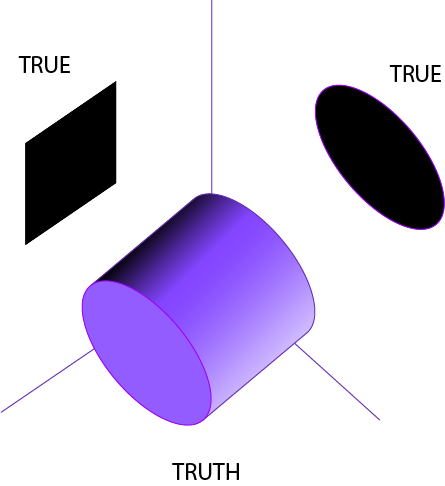
The answer is understanding that there are solutions contained within both groups. To think that either The Blue Group or The Red Group alone has all of the answers and the best ideals for the longevity of the country is suspect, at best, and likely bound to fail
It is time to put group politics aside, to work within the Constitution instead of spending so much effort to circumvent it. It is time to put the future of our country first - not our future, but the future for our children, our grandchildren, and their children.